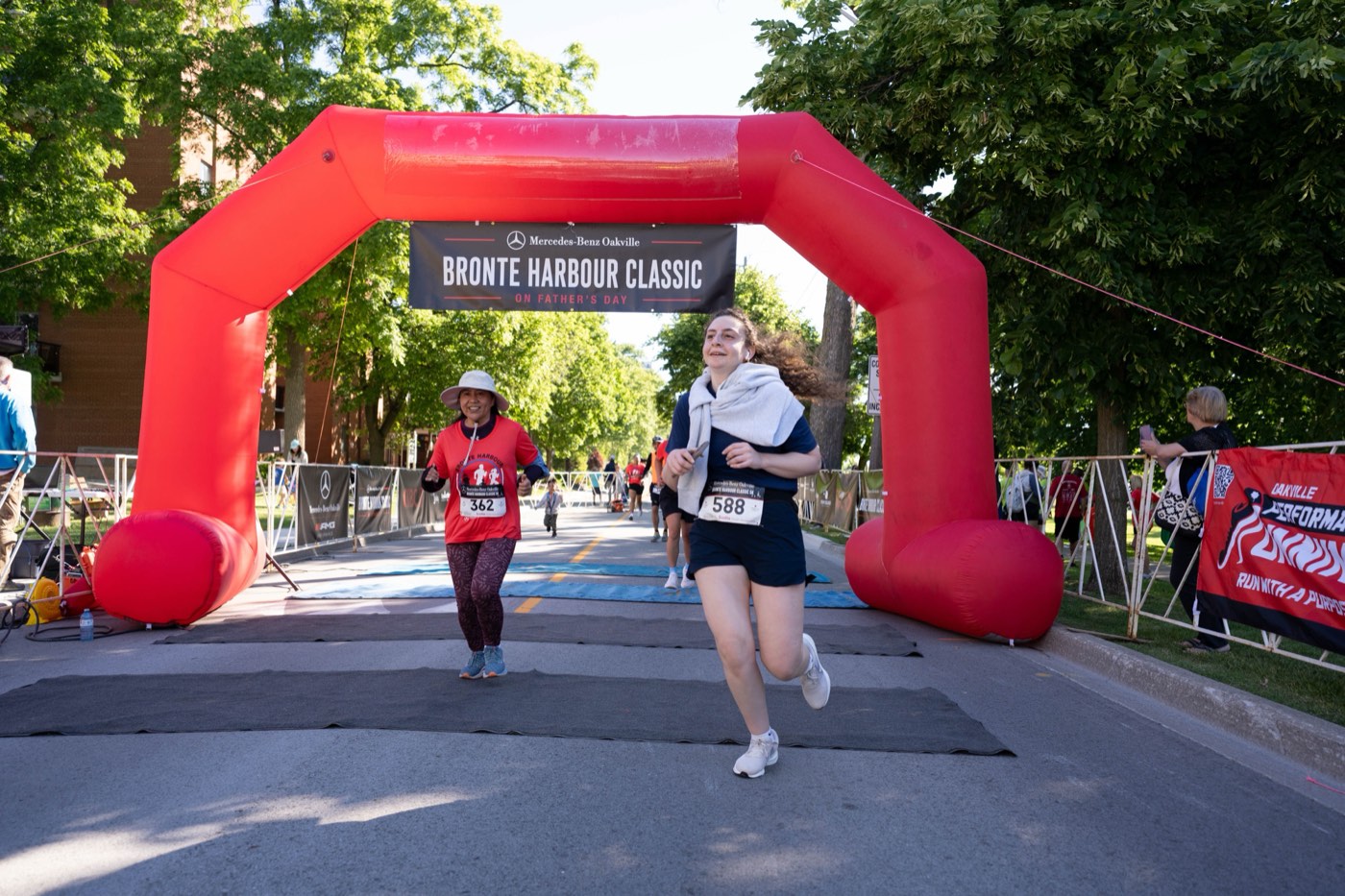
Turn your finisher medal over. See that little square pattern stamped next to the event logo? That’s a race medal QR code, and it’s not decoration — point your phone’s camera at it and it opens the entire 2026 archive: your results, every photo you appear in, and the story of a first-year race that sold out on Father’s Day.
This post is part of Behind the Race — a series explaining why the Bronte Harbour Classic does things a little differently.
Quick Answer: Scanning the QR code on your Bronte Harbour Classic finisher medal opens the permanent 2026 archive at bronteharbourclassic.com/2026/ — your race results, every photo you appear in searchable by bib number, and pages for all 80 sponsors and vendors. No app needed, just your phone’s camera.
Why we put a QR code on the medal at all
Most race medals do one thing: prove you finished. Ours does that too, but we didn’t want the medal’s job to end the moment you took it off. So we gave it a second life — a working link stamped right into the metal, pointing back at the permanent archive our Race Co-Director Greg Kowalczyk built for the 2026 race.
It’s a small addition to the medal design. It just happens to turn a keepsake into a door you can walk back through any time. Greg wrote up the technical side of that decision — why we chose an open QR standard over a fancier proprietary chip, and what it actually took to get it onto the medal — on his own site: Why Our Medals Have QR Codes (When No One Else’s Do).
What actually happens when you scan it
Point any smartphone camera at the code — no app, no download, no account to create. Your phone recognizes it the same way it recognizes any QR code and shows you a link. Tap it, and you land on the 2026 archive. From there:
Your results are waiting. Your finish time, your place, the full results list from race morning — the same list that shows Adam Schmidt crossing first overall in 14:43 and Sadie-Jane Hickson leading the women’s field in 16:34.
Your photos find you. Head into the photo gallery and type your bib number — every photo you appear in comes up automatically, free to download at full quality. No checkout, no watermark you have to pay to remove.
The sponsors and vendors who made the day happen. All 80 of them have their own page in the archive, with real race-day photos and their story — the local businesses that backed a race nobody had heard of yet.
The drone footage. Race morning from above, in short chapters — the start corral filling up, the course along the waterfront, the whole festival spread across Bronte Heritage Waterfront Park.
Why we didn’t use something fancier
We could have used an NFC chip instead — tap the medal against a phone instead of scanning it, which sounds more high-tech. We didn’t, for a simple reason: a QR code works on every smartphone camera already in every runner’s pocket, with nothing to install and nothing that depends on one company’s technology staying around. An NFC chip usually needs a specific app or a particular tap technique to read correctly; a QR code just needs a camera, which every phone already has built in. Fancier isn’t always better when the whole point is that it has to work for the next ten years, not just this one.
Kids get one too
Every Kids 1K finisher has the same QR code on their medal, and it opens onto the same archive. For a lot of the youngest runners, that medal came from crossing their very first finish line at 8:00 AM before the 5K even started — and now the metal in their hand does something a plain trophy never could: it pulls up their own photo, taken that morning, any time a parent hands them the phone to look. It’s a small thing, but it’s the same permanence promise for a six-year-old’s first race as it is for anyone chasing a personal best in the 5K.
Why this matters for sponsors and vendors too
Here’s the part that connects back to why every sponsor and vendor gets their own page: the QR code on a medal is one of the main doors runners actually walk through into the archive. Every scan is a chance for a runner to land on a sponsor’s page and see, in real race-day photos, exactly who showed up for the community on Father’s Day. That’s not a hypothetical benefit we’re promising 2027 partners — it’s already happening every time someone flips over their medal.
Try it at the dinner table
This is the fun part. Next time your family’s together, hand someone your medal and tell them to scan it. Watch them find your exact finish-line photo, your time, and the story of the morning — all from a piece of metal that looked, until thirty seconds ago, like it just sat in a drawer.
It works just as well a year from now. Five years from now. The archive isn’t going anywhere, and neither is the link on your medal.
What if the code won’t scan?
If a medal picks up enough scratches over the years that the code stops reading cleanly, the destination is also printed in plain text nearby: bronteharbourclassic.com/2026/. Type it into any browser and you land in exactly the same place. The QR code is the fast way in — it’s not the only way in.
Quick questions, quick answers
What does the QR code on my Bronte Harbour Classic medal do?
Scanning it opens the permanent 2026 archive — your race results, the free photo gallery searchable by bib number, drone footage of the whole morning, and pages for every sponsor and vendor who supported the race. It works with any smartphone camera, no app required.
Do I need to download an app to scan my race medal?
No. Every modern smartphone’s built-in camera can read a QR code without any extra app or account. Just point your camera at the code on the medal, tap the link that pops up, and you’re in the archive.
Will the race medal QR code still work in a few years?
Yes — the archive it points to is a permanent commitment, not a page that gets taken down after the season. The URL is designed to never change, so the code on your medal keeps working exactly the same way years from now.
What if my medal’s QR code gets scratched or won’t scan?
The web address is also printed near the code in plain text: bronteharbourclassic.com/2026/. You can type that directly into any browser and reach the same archive, no scanning required.
Why didn’t the race use an NFC chip instead of a QR code?
A QR code works with the camera already built into every runner’s phone — no special reader, no app, no dependency on one company’s proprietary technology. That reliability across every device, for as long as the archive exists, mattered more to us than a flashier tap-to-scan feature.
Mark your calendar: the Bronte Harbour Classic returns Sunday, June 20, 2027 — 5K, 10K, and the Kids 1K, back at Bronte Heritage Waterfront Park. If your business wants a permanent page like the ones your medal links to, sponsor the race or apply for the vendor expo — we’re already deep into planning next year.